SMAS vs. Deep Plane Facelift: Which Technique Produces More Natural Results?

Facelifts have come a long way—from simply tightening skin to repositioning the deeper support layers along the same vectors you had when you were younger. Today, two strategies dominate the conversation: SMAS-based facelifts and deep plane facelifts. Both can look fantastic when matched to the right face. But they differ in how they’re done, which ligaments are released, how tissues are anchored, how recovery feels, and—most importantly—how natural the results look in motion and at rest. Let’s break down the anatomy, mechanics, evidence, and patient selection so you can see which approach might deliver the most authentic-looking rejuvenation for you (or your patients).

Facial Aging and the Facelift Landscape: Defining SMAS and Deep Plane

Aging isn’t just about sagging skin. It’s a mix of descent, deflation, skin quality changes, and ligament laxity. Understanding the SMAS and the retaining ligaments is the starting point.
 
Anatomy of aging: SMAS, retaining ligaments, and midface descent
  • The SMAS (superficial musculoaponeurotic system) is a fibromuscular layer that invests facial muscles and connects with the platysma in the neck. As it sags, fat pads and skin follow—hello jowls, deeper nasolabial folds, and a softer jawline.
  • Retaining ligaments—zygomatic and masseteric cutaneous ligaments, mandibular ligaments, and the orbicularis retaining ligament (ORL)—tether skin and SMAS to bone. Release them selectively and tissues move without cranking down on the skin.
  • The midface (malar fat pad, lid–cheek junction) flattens and drops with time. Lifting skin alone rarely fixes this—deeper mobilization is often needed.
SMAS techniques: plication, imbrication, and SMASectomy—what’s what
  • SMAS plication: fold and suture the SMAS without removing tissue. It’s quicker and less invasive, with modest control of lift direction.
  • SMAS imbrication: elevate skin, incise/advance the SMAS (sometimes removing a bit) and secure it to firm anchors like deep temporal or mastoid fascia for a sturdier, longer-lasting reposition.
  • SMASectomy: excise a strip of SMAS and stitch the edges together—great for debulking thicker faces and sharpening the jawline.
  • Variations include high-SMAS and extended SMAS, which work closer to the malar area to better influence the midface.
Deep plane principles: composite flap, ligament release, and vector re-suspension
  • Deep plane facelifts elevate a composite flap—skin, subcutaneous tissue, and SMAS together—after releasing key zygomatic and masseteric retaining ligaments.
  • Keeping skin attached to the SMAS lets the entire unit move as one. That means more anatomic repositioning (often more vertical), usually with less skin tension.
  • Strategic release of the ORL and malar retaining ligaments (when indicated) lets you lift the lid–cheek junction while protecting lower eyelid shape.
Historical context and indications
  • Early facelifts were skin-only—results didn’t last and often looked “pulled.” SMAS-based surgery improved both longevity and contour.
  • Deep plane evolved to better address the midface and nasolabial region—lifting deeper structures rather than stretching skin.
  • Today, both have wide indications. Deep plane is often chosen for noticeable midface descent; SMAS variations shine for jawline and neck refinement.
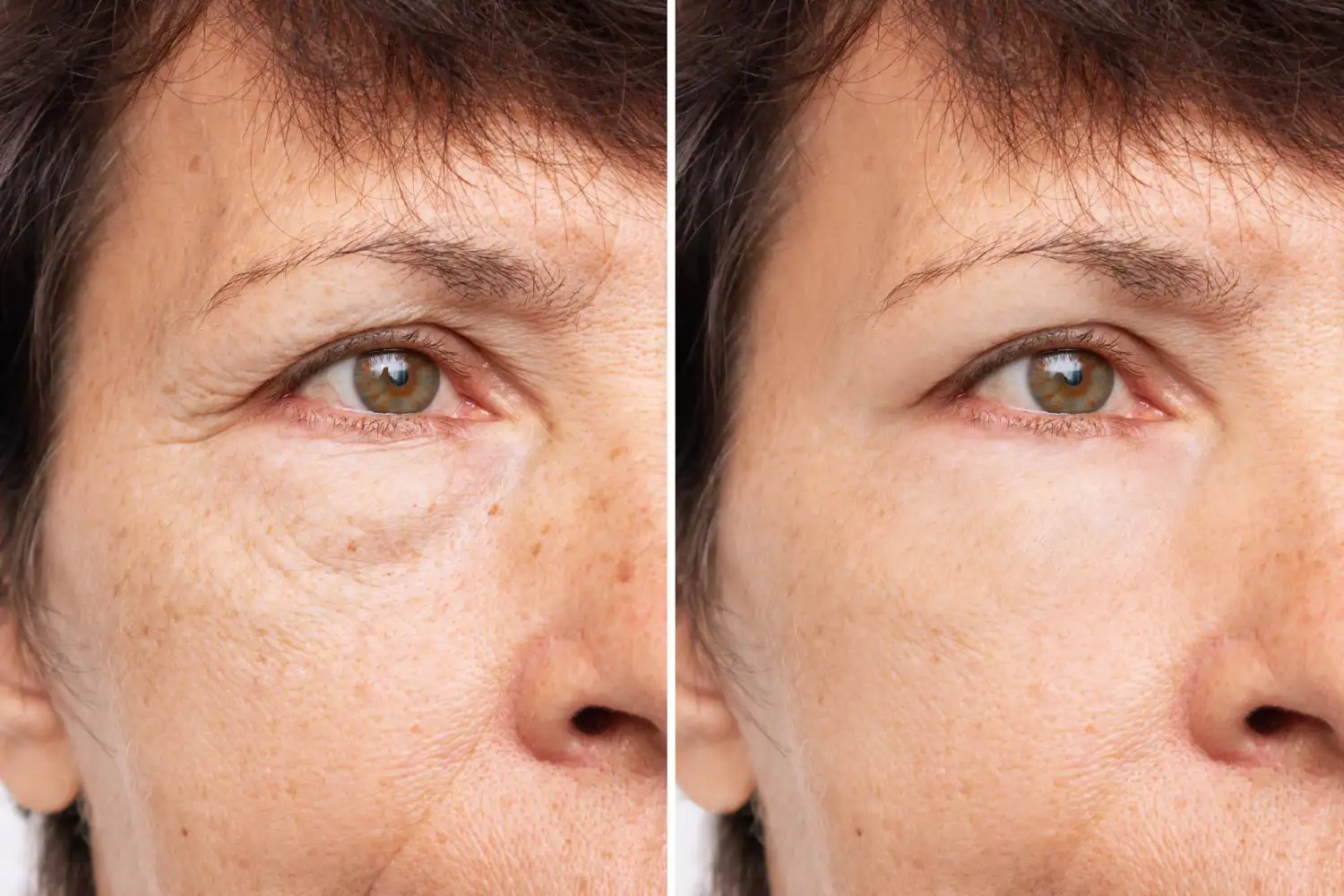
SMAS vs. Deep Plane Facelift

Surgical Mechanics: How Each Technique Achieves Rejuvenation

Curious how the techniques actually work under the hood? Here’s the short version.
 
Dissection planes and flap composition: skin-only vs composite
  • SMAS facelifts typically elevate a skin flap in the subcutaneous plane, then treat the SMAS with plication/imbrication/SMASectomy. Skin is draped back with low tension.
  • Deep plane facelifts elevate a composite flap deep to the SMAS over the parotid–masseteric fascia, often up to the zygomaticus major and into the malar region. Because skin and SMAS move together, you rely less on skin redraping to make things look right.
Release strategy: zygomatic and masseteric retaining ligaments, orbicularis retaining ligament
  • SMAS approaches may release selected ligaments indirectly or through extended dissections (like high-SMAS) to gain mobility.
  • Deep plane routinely releases zygomatic and masseteric retaining ligaments for midface and jowl freedom, with tailored ORL release when treating the tear trough/lid–cheek area. It’s measured—too much release can over-elevate or affect the lower lid.
Fixation and vectors: vertical, superolateral, and deep anchorage points
  • Vectors matter. More vertical vectors rejuvenate the midface; superolateral vectors refine the jawline and lateral cheek. In reality, surgeons blend them to fit the face.
  • Common anchors: deep temporal fascia, zygomatic arch periosteum, mastoid fascia, and parotid–masseteric fascia. Strong anchors help results last and maintain natural expression.
Perfusion, edema, and biomechanics of tissue repositioning
  • Composite deep plane flaps preserve subdermal and perforator blood supply—one reason skin edges may fare better when the technique is done well. Less skin undermining also means fewer tension-related stigmata.
  • Deeper dissection can mean more early swelling and sometimes a slightly longer “puffy” phase, especially in the cheeks. Careful hemostasis and layered closure help.
  • Biomechanically, deep plane lifts the descended SMAS and malar fat pad back to where they used to be—rather than stretching skin to camouflage descent.

Natural-Looking Outcomes: Evidence, Aesthetic Criteria, and Longevity

What do we really mean by “natural”? Think movement, harmony, and proportion—not a face that looks tight or “done.”
  • Defining “natural”: dynamic expression, nasolabial–malar harmony, and cervicomental angles
  • Natural means you look good while talking and smiling: no lateral mouth tug, normal lower eyelid curvature, and a smooth lid–cheek transition (no hollows, no overfilled look).
  • Harmony between the nasolabial fold, malar projection, and a crisp cervicomental angle reads as fresh, not pulled.
Clinical data: FACE-Q, blinded-rater studies, and revision rates
  • Patient-reported tools like FACE-Q show high satisfaction for both SMAS and deep plane in experienced hands.
  • Blinded-rater studies often find deeper midface and nasolabial improvement after deep plane, with comparable jawline and neck changes across techniques. There’s no gold-standard randomized trial declaring one “best”—most data are cohort-based.
  • Revision rates are low for both. Some series note fewer midface-related secondary tweaks after deep plane; SMAS-based revisions often target persistent nasolabial folds or midface ptosis.
Midface and nasolabial fold improvement: where deep plane may excel
  • By moving the malar soft tissues as a unit, deep plane frequently produces a more believable cheek and a softer nasolabial fold—without a “filler-like” look.
  • Extended/high-SMAS can approach this in select patients, though full deep plane release typically offers more midface mobility.
Over-tightening, stigmata avoidance, and durability across techniques
  • Facelift stigmata” (pulled corners, pixie ears, swept sideburns) are less about the label and more about tension control, vector choice, and smart incision design.
  • Durability depends on deep fixation, skin quality, and lifestyle. Deep plane often holds midface position longer; with solid SMAS work and platysma management, jawline and neck results can be equally durable.

Bottom line: if “natural” to you means a lively, lifted midface with soft folds and normal expression, deep plane often has the edge. If it means a crisp jawline/neck with streamlined recovery, SMAS imbrication or SMASectomy can be stellar.
SMAS vs. Deep Plane Facelift

Patient Selection and Customized Planning

No two faces age the same. The most natural result starts by matching the plan to the person.
 
Candidacy variables:
  • Age and skin quality: Younger patients with thicker, springy skin tend to do well with SMAS plication/imbrication. Thinner, photoaged skin benefits from reduced surface tension (deep plane or meticulous redraping) plus resurfacing.
  • Volume status: Deflated faces need fat grafting or fillers—lifting alone can deepen hollows.
  • Prior surgery: In revisions with subcutaneous scarring, deep plane can glide under scarred layers and reposition tissues more predictably.
  • Health and habits: Smoking, uncontrolled hypertension, and diabetes raise risks and may limit how much dissection is wise.
Pattern-based planning:
  • Jowls with early neck laxity (mid-40s to 50s): SMAS imbrication with targeted ligament release; add limited deep plane for midface if needed.
  • Pronounced midface ptosis and deep nasolabial folds (50s to 60s): Deep plane for malar lift; add platysmaplasty for the neck.
  • Heavy neck with platysma banding: Combine either approach with anterior platysmaplasty, subplatysmal fat management, and strong posterior platysma suspension.
Adjuncts:
  • Fat grafting to the malar, temple, prejowl, and perioral areas restores youthful shape.
  • Platysmaplasty (medial and/or lateral) sharpens the cervicomental angle.
  • Skin resurfacing (fractional CO₂ or erbium) improves texture and fine lines—timed to protect blood flow in the flap.
  • Energy devices (RF microneedling, ultrasound) help maintain skin quality after healing—just avoid aggressive treatments over fresh flaps.
Ethnic, gender, and anatomical nuances:
  • Male patients often have thicker skin, stronger ligament support, and higher hematoma risk—vector choices should avoid feminizing the face.
  • Darker skin types call for incision placement that respects hair patterns and a scar-minimization plan to reduce hypertrophic risk.
  • High cheekbones vs flatter malar contours guide how much midface elevation and volume to use—stay true to identity and balance.

Risk, Recovery, and Choosing the Right Surgeon

Surgery is surgery—know the risks, know the timeline, choose wisely.
 
Complication profiles:
  • Hematoma is the most common early issue; risk rises with hypertension, male sex, and BP spikes. Meticulous hemostasis and blood pressure control are key.
  • Temporary neuropraxia of facial nerve branches (temporal, zygomatic, buccal, marginal mandibular) can occur; rates are low in experienced hands. Deep plane works closer to motor branches, so anatomy matters.
  • Skin necrosis risk goes up with smoking and high skin tension. Composite flaps help perfusion, but smoking cessation and gentle redraping are non-negotiable.
  • Others: parotid fistula/sialocele, hair loss along temporal incisions, scar hypertrophy, and rare DVT/PE.
Recovery timelines:
  • Edema and bruising: typically 1–3 weeks. Deep plane may have slightly longer cheek swelling.
  • Return to work/social: many feel presentable at 10–14 days (makeup and hair help); most feel fully discreet by 3–4 weeks.
  • Sensation and firmness: numbness/tightness ease over 2–6 months as tissues remodel.
  • Scar maturation: 6–12 months, with subtle improvements beyond.
Informed consent and expectation management:
  • Standardized photos, clear goals, and when useful, image morphing keep everyone aligned.
  • Staging procedures (blepharoplasty, brow lift, resurfacing) can improve safety and outcomes—no need to do everything at once.
  • Be clear about limits (e.g., perioral dynamic lines may need adjuncts; surgery can’t change intrinsic skin elasticity).
Surgeon experience, learning curve, and setting:
  • Deep plane has a steeper learning curve; outcomes strongly correlate with surgeon volume and training. SMAS techniques demand equal precision for natural results.
  • Verify board certification (plastic surgery or facial plastic surgery), case numbers, before–afters, and patient reviews.
  • The surgical setting should be accredited (office OR, ASC, or hospital) with proper anesthesia support and protocols for VTE prophylaxis and BP management.

SMAS vs. Deep Plane Facelift

So, Which Technique Looks More “Natural”?

  • If your top concern is a flat, descended midface with pronounced nasolabial folds—and you want that smooth lid–cheek connection without tight-looking skin—deep plane often delivers the most convincing, natural correction by moving the real support structures together.
  • If you’re prioritizing jawline definition and neck refinement with a shorter operation and potentially less swelling, SMAS imbrication or SMASectomy can be outstanding—especially paired with modern platysma work and thoughtful volume restoration.
  • Ultimately, the most natural facelift is the one that:
    1. Releases the right ligaments for your anatomy,
    2. Uses the correct vectors,
    3. Rebalances volume thoughtfully, and
    4. Redrapes skin without tension or distortion.

Real-World Scenarios

  • A 52-year-old with early jowling, mild neck laxity, and good cheekbones: SMAS imbrication with lateral platysma suspension and a touch of fat to the prejowl sulcus yields a fresh, undetectable change—plus an efficient recovery.
  • A 61-year-old with midface descent, deep nasolabial folds, and hollowing at the lid–cheek junction: Deep plane facelift with selective ORL release and malar repositioning restores cheek fullness and softens folds without “pulled” corners. Add medial platysmaplasty for the neck.
  • A 58-year-old seeking revision after a prior skin/SMAS plication: Deep plane dissection under scarred layers allows safe mobilization and anatomic repositioning—reducing the “pulled skin” look and improving midface support.

Key Takeaways

  • Both SMAS and deep plane facelifts can look natural—the real difference is often in midface impact and how the result ages.
  • Deep plane typically excels at authentic midface rejuvenation and softening nasolabial folds by lifting the SMAS–malar complex as one.
  • SMAS variants are superb for jawline/neck refinement, with less invasive options for earlier aging changes.
  • Evidence (FACE-Q, blinded ratings) shows high satisfaction across techniques, with a trend toward better midface changes in deep plane cohorts.
  • Customization, surgeon expertise, tension-free skin redraping, and smart use of volume/skin treatments matter as much as the named technique.

Conclusion

There’s no monopoly on “natural.” It comes from anatomy-driven surgery done thoughtfully. Deep plane facelifts often provide the most lifelike midface and nasolabial rejuvenation, while SMAS-based approaches remain highly effective for sharpening the jawline and neck—with efficient recoveries. The ideal procedure is the one that fits your anatomy, aging pattern, and goals—and is performed by a surgeon who does it exceptionally well. Book a thorough consult, review before–after photos of faces like yours, and craft a plan that blends release, vector, volume, and skin strategy for a result that looks like you—on your best day.
Proper incision care

Schedule Your Appointment 
with Dr. Mourad

If you are considering facial plastic surgery and want results that enhance your natural beauty without looking overdone, schedule a consultation with Dr. Moustafa Mourad today. You will receive personal, expert guidance at every step—from your first visit to your final result.

From Our Blog

Best Facelift Surgeon
February 18, 2026 | Dr. Moustafa Mourad | Uncategorized

How to Choose the Best Facelift Surgeon Near You: A Practical, Evidence‑Based Guide

A great facelift can be life-changing—and it’s one of the most technically demanding procedures in aesthetics. Results depend as much on a surgeon’s judgment,
READ THE ARTICLE
What Is the SMAS
February 16, 2026 | Dr. Moustafa Mourad | Uncategorized

What Is the SMAS and Why It Matters in Facelift Surgery

Facelift surgery has come a long way from simply pulling skin tighter. The best, most natural results today are built on understanding a deeper support layer called the SMAS—the superficial musculoaponeurotic system.
READ THE ARTICLE
Deep Plane Facelift
February 14, 2026 | Dr. Moustafa Mourad | Uncategorized

What Is the Deep Plane Facelift and Why Surgeons Call It the Gold Standard

Aging in the lower face and neck isn’t just about “extra skin.” It’s about the deeper support system loosening—ligaments stretching, soft tissues dropping, and volume shifting around.
READ THE ARTICLE
How Long Does a Facelift Last
February 12, 2026 | Dr. Moustafa Mourad | Uncategorized

How Long Does a Facelift Last? The Truth About Longevity and Maintenance

A facelift is one of the most reliable ways to sharpen the jawline, smooth the midface, and refine the neck. But how long do the results actually last?
READ THE ARTICLE
X
Welcome to our website