Anatomy and Why Jowls and Marionette Lines Happen
Understanding the “why” helps explain which treatments actually work.
Age-related facial changes:
Age-related facial changes:
- Fat compartment descent and redistribution: As the superficial musculoaponeurotic system (SMAS) weakens, lower-face fat pads—especially jowl fat—slide over the mandibular border. At the same time, the prejowl sulcus and chin deflate, making the contrast more obvious.
- Skeletal remodeling: The mandible resorbs with age (most notably in the front), reducing bony support around the prejowl area and the menton (chin). Result: deeper marionette folds and a scalloped jawline.
- Dermal ECM degradation: Collagen and elastin decline, so the skin loses snap-back—laxity folds instead of draping smoothly.
- The SMAS (face) and platysma (neck) form a continuous fibromuscular hammock that holds everything up.
- Retaining ligaments—especially the mandibular and labiomandibular—tether skin to bone. As nearby tissues descend, these fixed points create the marionette crease and that “break” along the jawline.
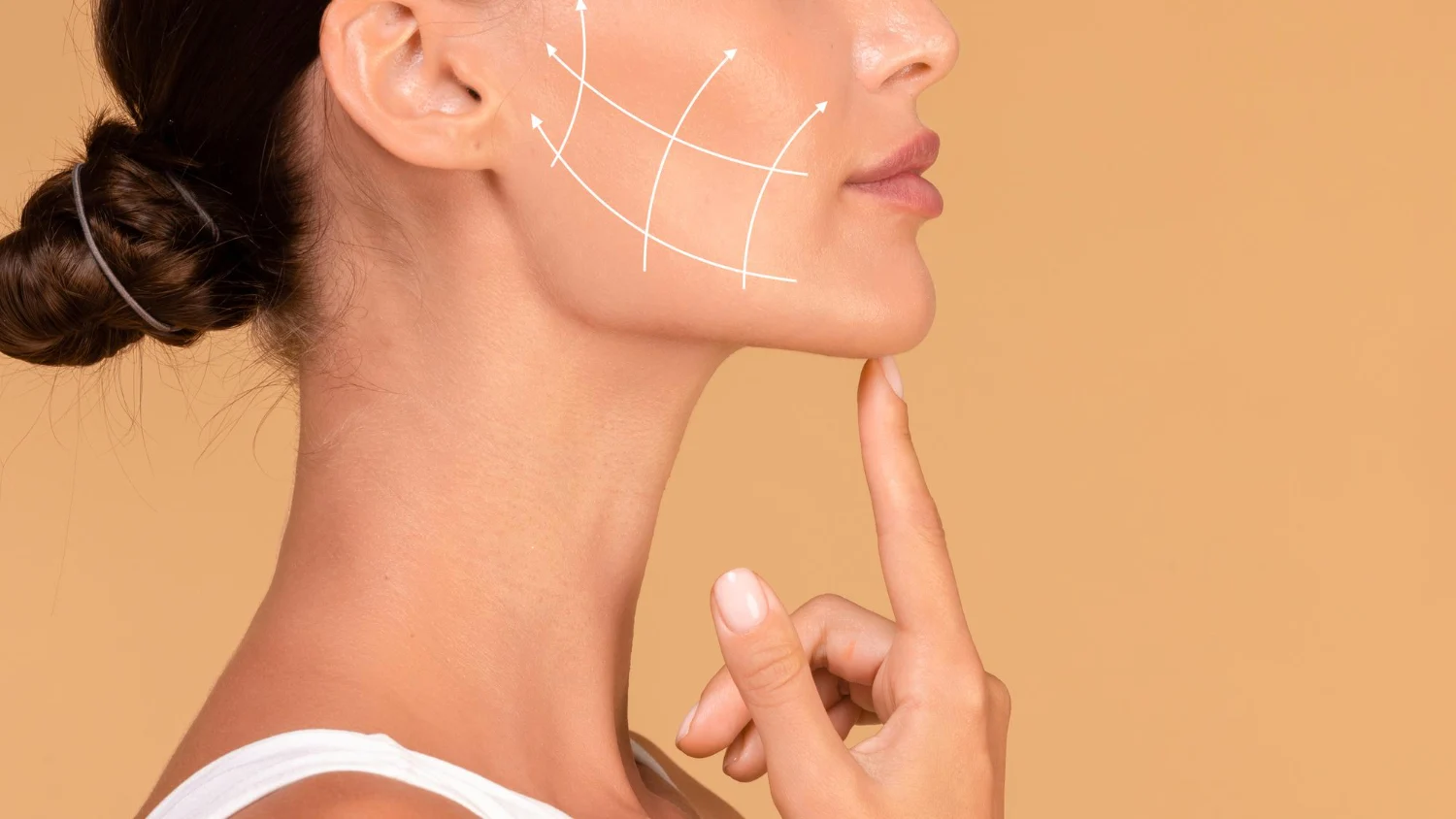
- Gravity and repeated expression pull tissues inferomedially. This creates a bulge (the jowl) just lateral to the marionette line and a hollow (prejowl sulcus) just in front of it. The labiomandibular fold deepens where ligaments resist the slide.
- True jowls vs. pseudo-jowls: True jowls come from ptosis of jowl fat and the SMAS. Pseudo-jowls are often from volume loss at the prejowl sulcus, chin retrusion, or edema/filler malposition that exaggerates a small jowl by contrast.
- Skin laxity vs. volume deficiency: Laxity lifts best; hollows and skeletal shortfalls respond to augmentation (fat grafting or implants).
- Bite/menton support: Dental occlusion, missing teeth, and chin projection all affect lower-face support. A retrusive chin or reduced lower facial height can deepen marionette lines—sometimes warranting a facelift plus a chin implant or even a referral to optimize occlusion.
Longevity—and What “Permanent” Really Means
“Permanent” is the wrong word. A facelift turns back the clock; it doesn’t smash it. The real question: how long do the improvements hold, and how do they age?
Expected durability:
Expected durability:
- Well-executed SMAS-based facelifts typically keep a noticeable improvement for 8–12 years, sometimes longer. Deep-plane and high-SMAS techniques often deliver sturdier lower-face and midface support than skin-only or limited plication lifts.
- Relapse is gradual. Jowls and marionette lines usually improve dramatically in the early years, then slowly reappear as tissues keep aging and elasticity wanes.
- Skin quality and sun history: UV accelerates collagen breakdown and can shorten how long that crisp definition lasts.
- Weight changes: Big swings in weight can stretch or deflate tissues and alter contours.
- Smoking/vaping: Nicotine compromises microvasculature—raising complication risks and hurting long-term tissue quality.
- Age and genetics: Older patients and those with thin, inelastic skin may relax sooner than younger patients with thicker dermis.
- Release and fixation: Thorough ligament release with secure, well-chosen SMAS/platysma fixation boosts longevity.
- Vector planning: Customizing lift vectors to anatomy (e.g., more vertical in heavy necks, superolateral in the lower face) preserves natural movement and shape.
- Added support: Augmenting the prejowl sulcus and chin “fills the deficit,” making folds less likely to return.
- Hematoma is the most common early issue, usually within 24 hours—risk is higher in men and when blood pressure isn’t tightly controlled.
- Temporary facial nerve weakness (often marginal mandibular) can happen; permanent motor injury is rare. Numbness from great auricular nerve irritation is more common and often improves.
- Skin necrosis and delayed healing show up more in smokers. Hypertrophic scars, incision-line alopecia, and salivary problems (like sialocele) are uncommon but known.
- Revision/touch-up rates vary by surgeon and technique, often 5–15% over several years—usually for minor asymmetries, recurrent banding, or renewed jowling with further aging.
Candidacy, Prep, and Aftercare
Good planning and careful aftercare move the needle—sometimes more than you’d think.
Consultation workflow:
Consultation workflow:
- Multi-view photos (including oblique shadows) help quantify jowls and marionette depth.
- Vector mapping and, when available, imaging simulation clarify goals and set expectations.
- Informed consent should cover options, trade-offs (incisions, downtime), and the difference between “better” and “perfect.”
- Anesthesia: Local with sedation or general—depends on extent and patient preference.
- Hemostasis and blood pressure: Meticulous intraoperative hemostasis and tight BP control reduce hematoma risk. Some surgeons use drains, quilting sutures, or sealants.
- VTE prophylaxis: Individual risk (e.g., Caprini score) guides compression and, when needed, chemoprophylaxis.
- Medication management: Pause bleed-risk agents (aspirin, NSAIDs, many herbals) as directed; coordinate anticoagulants with prescribers. Optimize blood pressure and glucose control.
- Days 1–3: Tightness, swelling, bruising peak; dressings and drains (if any) come out per protocol.
- Days 4–10: Bruising fades; most people feel presentable by days 10–14 with camouflage makeup.
- Weeks 3–6: Residual swelling keeps settling; light exercise often at two weeks, full activity by 4–6 weeks.
- Months 3–12: Sensation normalizes and incision redness fades; scars mature over 6–12 months.
- Daily SPF, nighttime retinoids as tolerated, and consistent skincare protect dermal quality.
- Keep weight steady. Quit smoking—nonnegotiable for long-term tissue health.
- Periodic nonsurgical “tune-ups” (neuromodulators, light fractional resurfacing, conservative fillers) can extend that refreshed look and treat lines surgery doesn’t target.


From Our Blog

What Is a Deep Plane Facelift and Why Do Top Surgeons Prefer It?
The deep plane facelift has become the go-to choice for many top facial plastic surgeons—and for good reason. Instead of just pulling skin tight, it works where aging actually happens: in the deeper support layers of the face.
READ THE ARTICLE
What’s the Safest Age to Get a Facelift—and When Is It Too Early?
There isn’t a magic birthday for a facelift. The “safest” age is when your anatomy and skin will clearly benefit more from surgical lifting than from nonsurgical fixes—and when your health makes an elective procedure low risk.
READ THE ARTICLE
Mini Facelift vs. Full Facelift: Technical Differences, Candidacy, and Outcomes
A facelift isn’t one single operation—it’s a range of techniques tailored to how (and where) you’re aging. “Mini facelift” and “full facelift” are common labels, but they point to very different levels of dissection, how deeply tissue is moved, and how much work is done in the neck.
READ THE ARTICLE
Is a Facelift Worth It Compared to Non-Surgical Alternatives? A Clinical, Economic, and Patient-Centered Analysis
Interest in facial rejuvenation has never been higher, but the menu of options—from injectables and energy devices to deep-plane facelifts—can feel overwhelming. Patients often ask a deceptively simple question: is a facelift “worth it” compared to non-surgical treatments?
READ THE ARTICLE