Double Board Certified · Combined Functional & Aesthetic Nasal Surgery
Septorhinoplasty in NYC — one operation for function and form.
A septorhinoplasty is not two procedures performed at once — it is one operation, planned and executed as a single architectural problem. The septum and the external nose share their skeleton; refining one without considering the other rarely ends well.
ABFPRS
Facial Plastic & Reconstructive Surgery
ABOto
Otolaryngology — Head & Neck Surgery
AAFPRS
Fellowship Director
In Consultation
"When breathing and appearance are addressed together, the result is more honest than the sum of two separate operations."

A Note from Dr. Mourad
"A septorhinoplasty is not two procedures performed at once — it is one operation, planned and executed as a single architectural problem. The septum and the external nose share their skeleton; refining one without considering the other rarely ends well."
— Dr. Moustafa Mourad, MD
Medically reviewed by Moustafa Mourad, MD, FACS — dual board-certified Facial Plastic & Reconstructive Surgeon and Otolaryngologist (Head & Neck Surgery).
Last reviewed: June 2026
Is this the right page for you?
This page is for
- You want to improve both breathing and the appearance of your nose in one operation.
- You have a deviated septum or airway problem together with a cosmetic concern about the bridge, tip, or profile.
You may be looking for
- If your concern is breathing alone, see septoplasty.
- If your concern is appearance alone and you have never had surgery, see primary rhinoplasty.
Overview
What is septorhinoplasty?
Septorhinoplasty is a combined operation that reshapes the external appearance of the nose (rhinoplasty) and straightens the internal nasal septum (septoplasty) in a single procedure. The functional and aesthetic components are planned together, so that breathing improvement and refinement of shape happen on the same anatomy at the same time.
It is considered when a patient has both a cosmetic concern — dorsal hump, deviated bridge, bulbous or asymmetric tip, over- or under-projection — and a functional concern such as a deviated septum, narrow nasal valves, or persistent nasal obstruction. Addressing both at once avoids a second operation and a second recovery.
When indicated, septoplasty performed at the time of rhinoplasty also provides septal cartilage that may be needed as graft material to support the new nasal framework — a structural advantage that benefits both the breathing and the long-term shape of the nose.
An Established Academic Authority
Double board certification. Fellowship director. Published author. A surgeon's surgeon.
ABFPRS
Board Certified
American Board of Facial Plastic & Reconstructive Surgery
ABOto
Board Certified
American Board of Otolaryngology — Head & Neck Surgery
AAFPRS
Fellowship Director
American Academy of Facial Plastic and Reconstructive Surgery
Textbook
Published Author
Contributions to the academic literature of facial plastic surgery
Dual board certification in both Facial Plastic & Reconstructive Surgery and Otolaryngology — a combination held by a small number of physicians nationally.
02 · Ideal Candidates
Who benefits most from this operation.
Candidacy is determined together at consultation. The most satisfied patients share three things in common.
I
Function and Form
Patients with both a documented breathing problem and clear cosmetic concerns about the external nose — addressing them together is structurally and financially more sensible.
II
Insurance Considerations
The functional component may be covered by insurance, while the cosmetic refinement is a private fee — the consultation explains both pathways clearly.
III
A Single Recovery
One anesthetic, one healing period — preferable to two separate operations spaced months apart with two recoveries.
If this describes you, the next step is a quiet, unhurried conversation — not a sales call.
An Honest Note
When this operation may not be right for you.
If your concerns are purely cosmetic with no functional issue, a rhinoplasty alone is the right operation.
If your concerns are purely functional with no interest in cosmetic change, a septoplasty alone is sufficient.
Active sinus disease is treated medically before any combined nasal surgery is undertaken.
Unrealistic expectations — about either component — are addressed during consultation; no operation is scheduled until the plan is honest.
03 · Approaches
The full range of options.
Septorhinoplasty combines functional and aesthetic correction. The right plan compares it honestly to functional-only and cosmetic-only alternatives, and accounts for adjuncts and patient-specific variations.
1 of 6 · Septoplasty Alone
04 · Technique
Open vs closed septorhinoplasty.
The choice between open and closed approach is dictated by the complexity of the work required — particularly when the tip needs precise reshaping or structural grafts are planned.
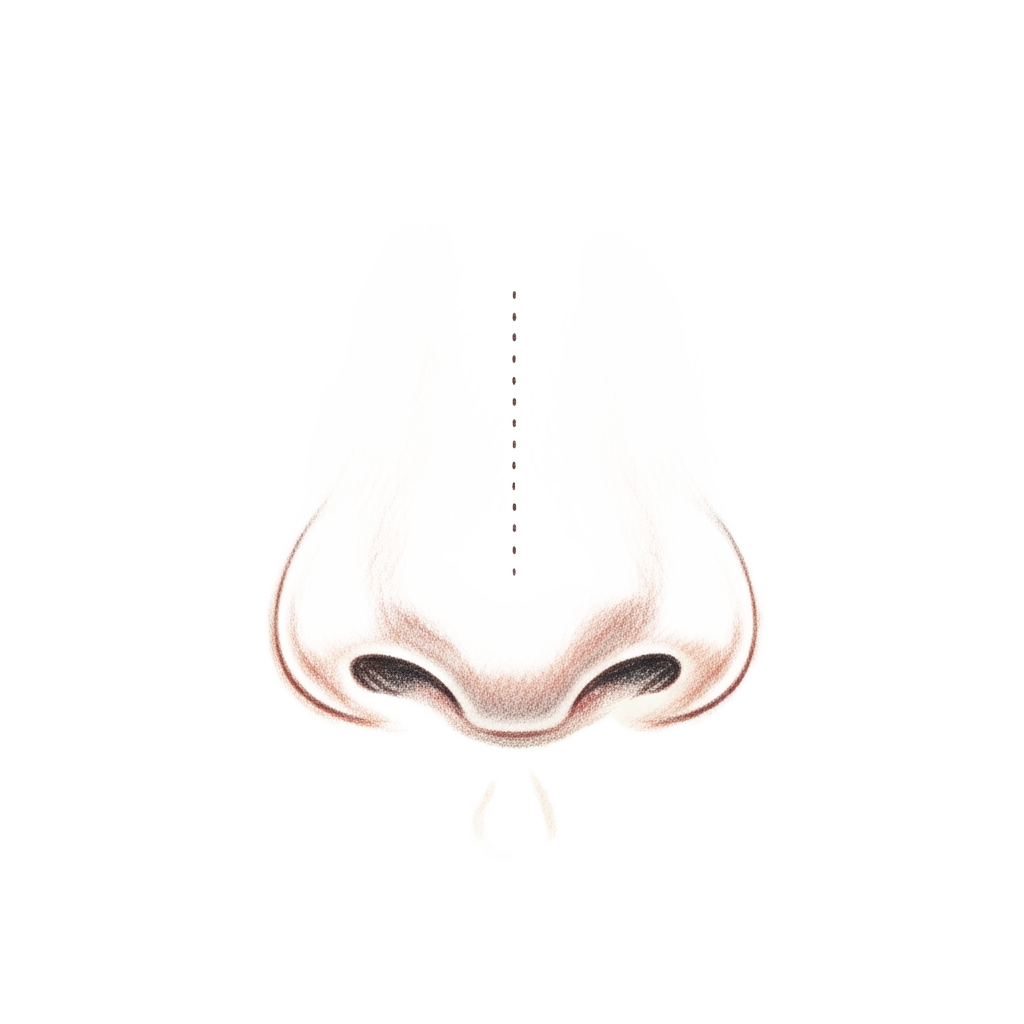
Open
Columellar Incision
An open approach uses a small incision across the columella, providing direct visualization of the entire nasal framework. Suture techniques and cartilage grafts can be placed with precision.
This is the approach of choice for revision cases, ethnic refinement requiring structural grafting, and complex tip work.
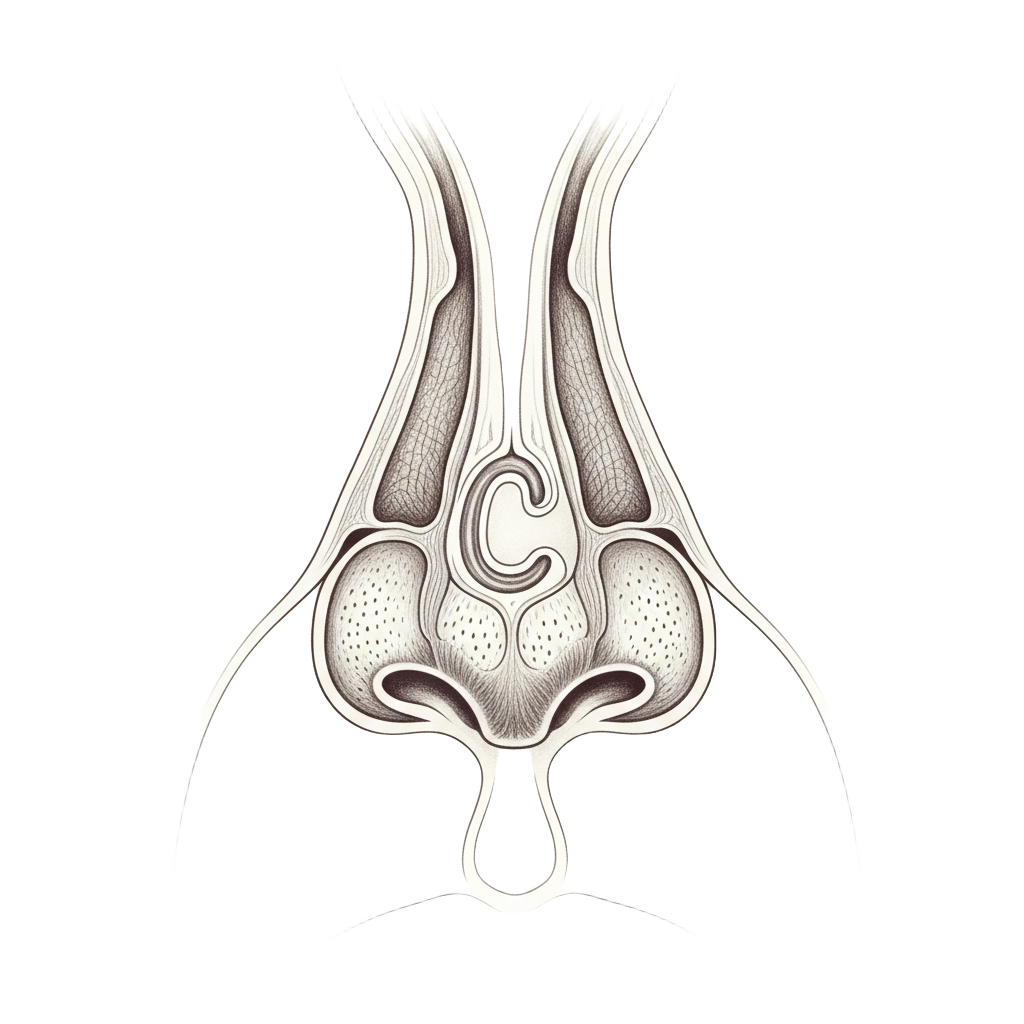
Closed
Endonasal
A closed approach works entirely through incisions inside the nostrils. There are no external scars and recovery can be slightly faster.
It is well-suited to selected primary cases with straightforward anatomy where dorsal reduction and septal correction are the main goals.
Both approaches are part of a complete septorhinoplasty practice. The plan is built around the patient.
01 · Why Dr. Mourad
A surgeon trusted by surgeons for this operation.
Dr. Moustafa Mourad is double board-certified by the American Board of Facial Plastic & Reconstructive Surgery and the American Board of Otolaryngology — Head & Neck Surgery, and serves as an AAFPRS Fellowship Director.
The practice concentrates on the operations of the face, nose, and sinuses — and on the patients other surgeons have found challenging.
Every consultation is unhurried, every plan is individual, and no operation is recommended unless it is the right one.
Begin the conversation
Plan function and form together, in a single, honest conversation.
Cost, Financing & Insurance
Septorhinoplasty Cost, Financing & Insurance in NYC
Septorhinoplasty combines functional septal and nasal airway work with reshaping of the nose, so cost depends on the complexity of both components, the techniques required, the type of anesthesia, and the surgical facility. Each plan is individualized after a combined functional and aesthetic evaluation.
The functional portion that treats nasal obstruction may be eligible for insurance coverage when it is medically necessary, while the cosmetic portion is generally considered elective and self-pay. Coverage depends on symptoms, examination findings, and the patient’s insurance plan. After consultation, our office provides a personalized estimate and can help review benefits for the functional component.
What May Affect Cost
- Complexity of functional and cosmetic goals
- Severity of septal deviation
- Techniques required
- Type of anesthesia
- Surgical facility
- Insurance plan requirements
This information is educational and is not a guarantee of pricing, insurance coverage, reimbursement, financing approval, or surgical candidacy. A personalized estimate is provided after consultation. Insurance coverage depends on the patient’s plan, medical necessity, documentation, and carrier requirements. Financing terms are determined by third-party financing providers.
05 · In Dr. Mourad's Words
Educational videos.
Short educational films and patient perspectives from the Manhattan practice.
Dr. Mourad in Practice
An overview of the practice and philosophy.
Patient Perspective
A patient discusses her experience before, during, and after surgery.
Inside the Consultation
How Dr. Mourad evaluates anatomy, goals, and candidacy.
From the Patient Gallery
A representative rhinoplasty result.
A female patient in her 20s, documented in standardized studio conditions before and after surgery. Written photographic consent on file. Results vary by patient; this case is representative, not predictive.
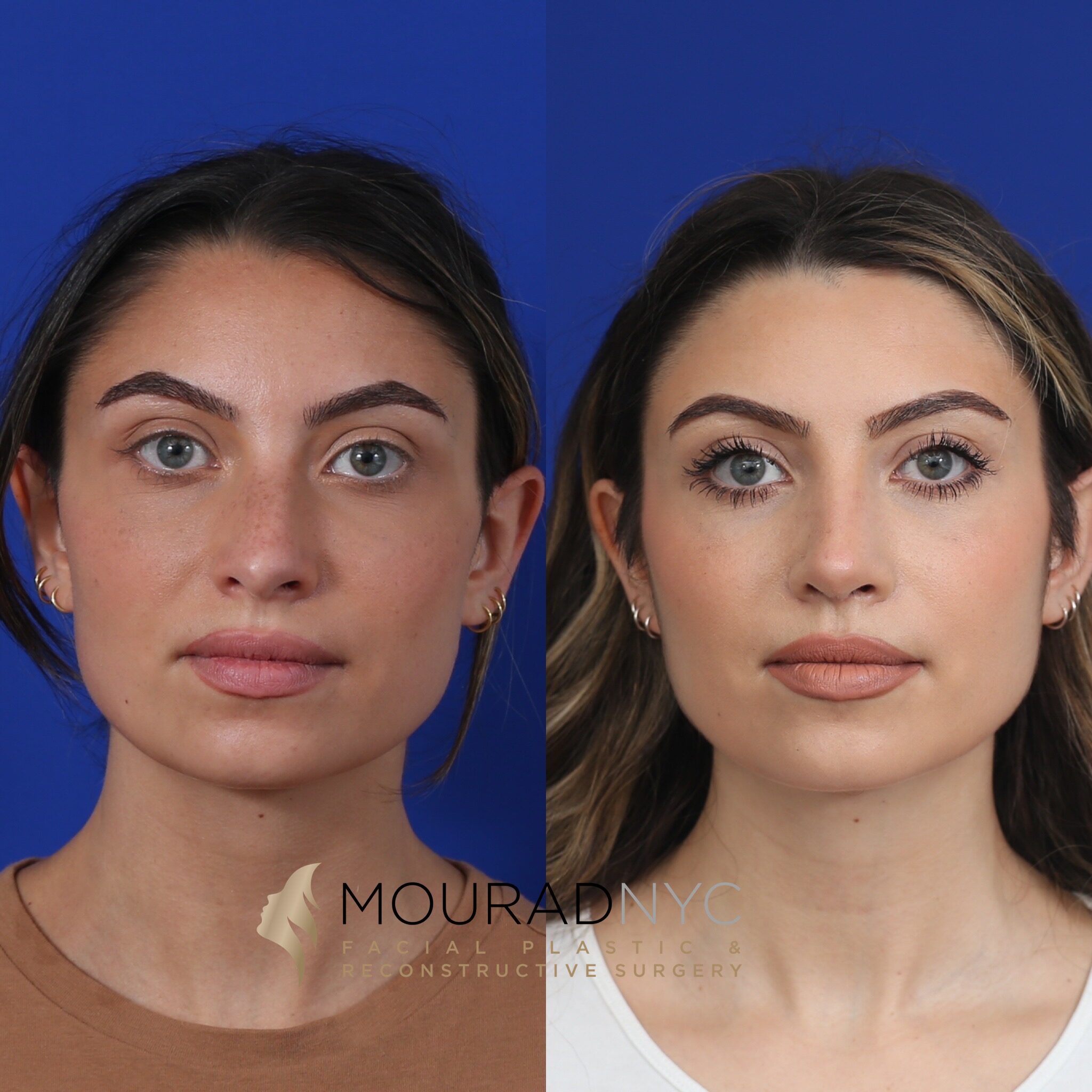


Pre and post-operative comparison · Written consent on file
06 · Recovery
What healing actually looks like.
Stage 01
First 24 Hours
A small external splint sits on the dorsum for the first week. Internal silicone splints are typically removed at the first post-operative visit.
Stage 02
Week 1
Bruising and swelling peak around day three and substantially fade through the first week. Most patients return to work-from-home by day five and to the office at one to two weeks.
Stage 03
Weeks 2 – 4
Through weeks two to four, the cosmetic shape begins to emerge. Light exercise resumes at three weeks; contact sports are deferred for several months.
Stage 04
Months 1 – 12
The final refined shape and full functional benefit are appreciated over six to twelve months as the tip swelling continues to resolve.
Have a specific question?
Send a brief note describing your anatomy or concerns — the office will route it directly to Dr. Mourad for review.

Before You Arrive
Your consultation, prepared.
Bring frontal, lateral, and three-quarter photographs of the nose for reference.
Bring any prior CT imaging of the sinuses and septum.
Note all prior nasal surgery and trauma in chronological order.
Begin the medication washout window per the instructions provided.
Plan for a one-week recovery and a quiet return to social life at two weeks.
Bring written questions. The conversation is unhurried.
Patient Reviews
Septorhinoplasty Patient Experiences
Selected public patient reviews. Individual experiences vary.
“I can now say I can breathe better than I ever have”
Real patient experiences
Selected public reviews from patients of the practice.
Your privacy matters
We never share personal health information.
Board-certified expertise
Dual board-certified facial plastic and reconstructive surgeon.
Individual results vary. Reviews reflect individual experiences and are not a guarantee of outcome.
Frequently Asked
Patient questions, honestly answered.
Evaluation begins with a focused history and external and internal nasal examination. Nasal endoscopy and standard photography are routine to document structure and mucosa. When anatomy is unclear or sinus disease is suspected, targeted imaging such as a CT scan is ordered. Objective airflow testing is used selectively when symptoms and exam disagree (see AAO‑HNS and MedlinePlus resources: https://www.entnet.org/content/nasal-obstruction/, https://medlineplus.gov/ency/article/001053.htm).
Prior surgery often creates scar tissue and may reduce available septal cartilage. Planning focuses on restoring support, which commonly requires grafting from septum, ear, or rib depending on need. Revision cases may be staged when airway or reconstruction complexity is high. Preoperative counseling emphasizes realistic goals and the potential need for longer operative time or secondary procedures (see preservation and revision strategy references: https://www.aafprs.org).
Not always. Minor septal adjustments can subtly alter dorsal alignment or tip position, but many septoplasties do not produce visible external change. When both airway and surface contour are a concern, a coordinated septorhinoplasty may be planned so internal correction and external reshaping occur together. The specific interaction depends on septal support and soft-tissue relationships identified at exam.
Typical preoperative workup includes a detailed symptom inventory, external photographs, and nasal endoscopy to inspect septum and mucosa. A CT scan is reserved for suspected sinus disease, trauma, or complex anatomy. Routine blood work or medical clearance is arranged based on comorbidities. The plan is finalized after in-person discussion with Dr. Mourad.
Approach is anatomy-driven. Open (external) exposure is preferred for complex tip reconstruction or most revision cases. Closed techniques are considered when adequate exposure allows precise reshaping without external incision. Preservation strategies are used when the native dorsum and ligamentous attachments can be maintained to protect airway support (see AAFPRS discussion: https://www.aafprs.org).
Grafts are indicated when native septal cartilage is insufficient to restore or reinforce support. Septal cartilage is the usual first choice. When septal cartilage is unavailable, auricular (conchal) cartilage is commonly used for moderate defects, and costal (rib) cartilage is reserved for major structural reconstruction. Donor-site risks and trade-offs are discussed during consent.
Turbinate reduction is performed when hypertrophy contributes to obstruction and may include outfracture, submucosal reduction, or energy-assisted techniques depending on mucosal health. Internal and external nasal valves are assessed and may be supported with spreader grafts, lateral wall suspension, or other targeted repairs. The objective is to restore physiologic airflow without excessive narrowing. Technique selection follows available guidance and individualized intraoperative assessment (see AAO‑HNS patient resources: https://www.entnet.org/content/nasal-obstruction/).
External nasal splints are typically removed at 7 to 10 days. When used, internal silicone splints or soft supports are commonly left for 5 to 14 days depending on surgeon preference and mucosal status. Traditional nasal packing is used less frequently; if placed it is usually removed within 24 to 48 hours. Specific timing is set at the operation and reviewed at the first postoperative visit.
Most patients can return to nonstrenuous work within 7 to 14 days. Light aerobic activity is usually permitted after 2 to 3 weeks; vigorous or contact sports are delayed for 6 to 8 weeks. Glasses that rest on the nasal bridge are typically avoided or taped to the forehead for 4 to 6 weeks and alternative support options are discussed. Healing varies by individual and follow-up visits adjust restrictions.
Insurance may cover clearly documented functional components such as septoplasty or turbinate surgery when medical necessity is demonstrated. Cosmetic elements are billed as elective procedures. Preauthorization and careful coding are used to separate functional from aesthetic charges when appropriate. Coverage decisions vary by carrier and are reviewed before scheduling.
Initial postoperative review is usually within 3 to 7 days, with subsequent visits at 2 to 3 weeks, 3 months, 6 months, and 12 months as needed. Functional assessment of airway and staged aesthetic refinements are performed during this period. Long-term surveillance focuses on airway stability, graft integrity, and patient-reported symptoms. Additional visits are scheduled if new obstruction or concerns arise.
Clinical references
This page draws on published clinical practice guidelines and public-health references. These sources inform general patient education and do not replace an individual evaluation with Dr. Mourad.
- 01Ishii LE, et al. Clinical Practice Guideline: Improving Nasal Form and Function after Rhinoplasty. Otolaryngology–Head and Neck Surgery. 2017;156(2 suppl):S1–S30. AAO-HNSF guideline
- 02U.S. National Library of Medicine (MedlinePlus). Nose Injuries and Disorders. MedlinePlus
The Most Important Step
Your expert consultation.
A septorhinoplasty consultation evaluates both the airway and the aesthetic — examination, often endoscopy and imaging, and a frank discussion about realistic outcomes for both.