Double Board Certified · Functional Nasal Surgery
Nasal Valve Collapse Treatment — structural support for the breathing nose.
Nasal valve collapse is one of the most under-diagnosed structural causes of nasal obstruction. When it is the right diagnosis, structural reconstruction —…
ABFPRS
Facial Plastic & Reconstructive Surgery
ABOto
Otolaryngology — Head & Neck Surgery
AAFPRS
Fellowship Director
In Consultation
"Patients have often been told for years that there is nothing wrong, when the nasal valve has been quietly collapsing on every breath."

A Note from Dr. Mourad
"Nasal valve collapse is one of the most under-diagnosed structural causes of nasal obstruction. When it is the right diagnosis, structural reconstruction — cartilage grafting that supports the sidewall — produces durable improvement."
— Dr. Moustafa Mourad, MD
Medically reviewed by Moustafa Mourad, MD, FACS — dual board-certified Facial Plastic & Reconstructive Surgeon and Otolaryngologist (Head & Neck Surgery).
Last reviewed: June 2026
Is this the right page for you?
This page is for
- You feel your nose collapse or pinch closed when you breathe in deeply.
- Breathing strips help, which often points to a weak or narrow nasal valve.
- Previous surgery, injury, or naturally weak cartilage has left the sidewall unsupported.
You may be looking for
- If the blockage is from a deviated septum, see septoplasty.
- If enlarged turbinates are the cause, see turbinate reduction.
Overview
What is nasal valve collapse treatment?
Nasal valve collapse treatment is a structural surgical procedure that reinforces the internal and/or external nasal valves — the narrowest segments of the nasal airway — using cartilage grafts harvested from the septum, ear, or rib. Common techniques include spreader grafts, alar batten grafts, and lateral crural strut grafts.
It is considered when a patient has persistent nasal obstruction that worsens with deep inspiration or exercise, when the sidewalls of the nose visibly collapse on breathing in, and when manual lateralization (Cottle maneuver) improves airflow. The diagnosis is made on examination, not on imaging alone.
When the cosmetic shape of the nose is also a concern, valve reconstruction can be combined with rhinoplasty so both function and form are addressed in one operation. When the only concern is breathing, the operation is purely functional and the external shape is preserved.
An Established Academic Authority
Double board certification. Fellowship director. Published author. A surgeon's surgeon.
ABFPRS
Board Certified
American Board of Facial Plastic & Reconstructive Surgery
ABOto
Board Certified
American Board of Otolaryngology — Head & Neck Surgery
AAFPRS
Fellowship Director
American Academy of Facial Plastic and Reconstructive Surgery
Textbook
Published Author
Contributions to the academic literature of facial plastic surgery
Dual board certification in both Facial Plastic & Reconstructive Surgery and Otolaryngology — a combination held by a small number of physicians nationally.
02 · Ideal Candidates
Who benefits most from this operation.
Candidacy is determined together at consultation. The most satisfied patients share three things in common.
I
Inspiratory Collapse
Patients whose nostrils visibly collapse inward with strong inhalation, or whose breathing improves with the Cottle maneuver (lateral pull on the cheek).
II
Failed Septoplasty
Patients who have had septoplasty without breathing improvement — valve collapse is a common missed diagnosis.
III
Post-Rhinoplasty Obstruction
Patients whose breathing was worse after prior rhinoplasty due to over-resection of supporting cartilage.
If this describes you, the next step is a quiet, unhurried conversation — not a sales call.
An Honest Note
When this operation may not be right for you.
Patients whose primary obstruction is from a deviated septum or enlarged turbinates benefit from septoplasty and turbinate reduction first.
Patients with primarily allergic obstruction benefit from optimised medical therapy first.
Patients whose dissatisfaction is driven primarily by mild discomfort that does not affect sleep or exertion may be reasonable to manage non-operatively.
Smokers should be counseled candidly about wound healing before any nasal surgery.
03 · Approaches
Three paths to a stable nasal valve.
The internal and external nasal valves are the narrowest points of the airway. The right graft depends on which valve has collapsed and why — structural correction is what holds the airway open in the long term.
1 of 3 · Spreader Grafts
04 · Technique
Internal vs external valve.
The two valves obstruct in different ways and require different grafts. The first job of consultation is to identify which valve is collapsing.
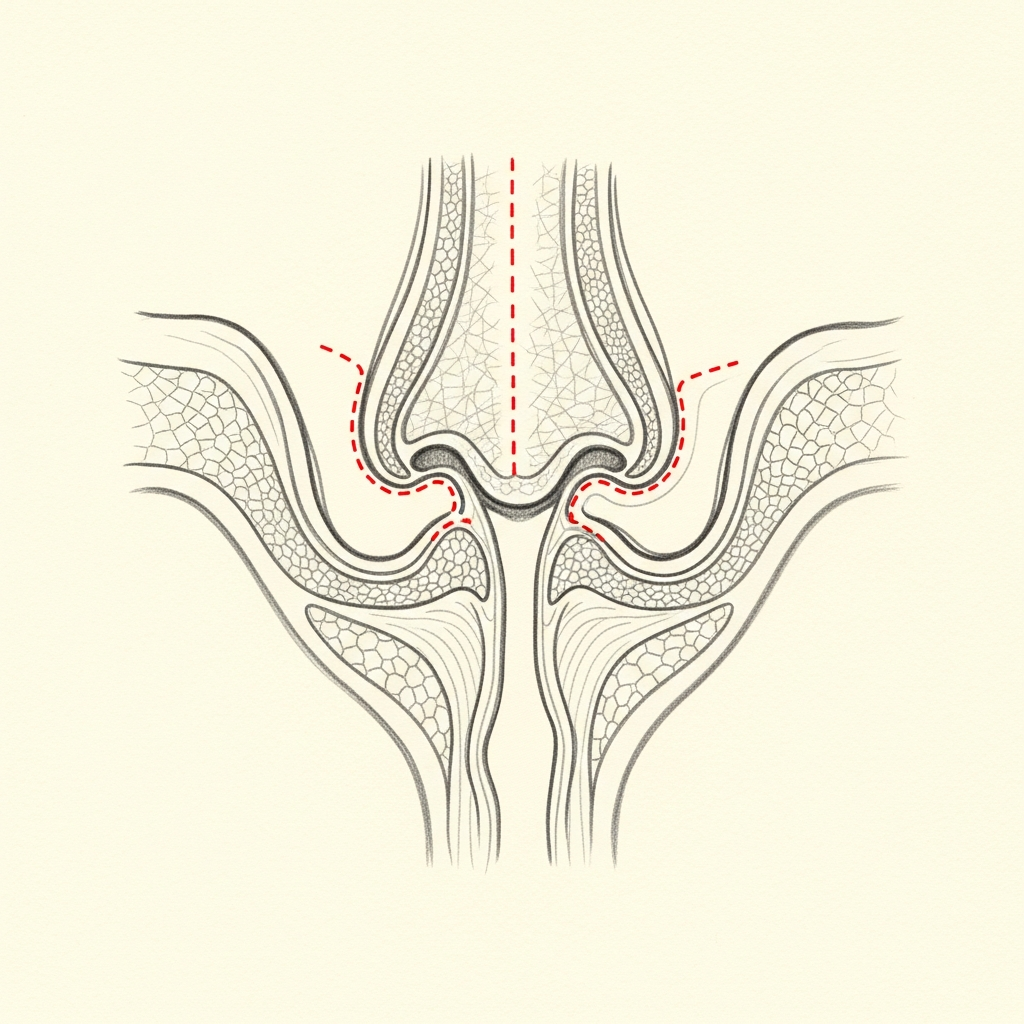
Internal
Spreader grafts
The internal nasal valve is the narrowest point of the airway — the angle between the upper lateral cartilage and the septum. Collapse here causes obstruction with every inspiratory breath.
Spreader grafts — strips of cartilage placed in the dorsal septal angle — widen this angle and restore the cross-sectional area of the airway.
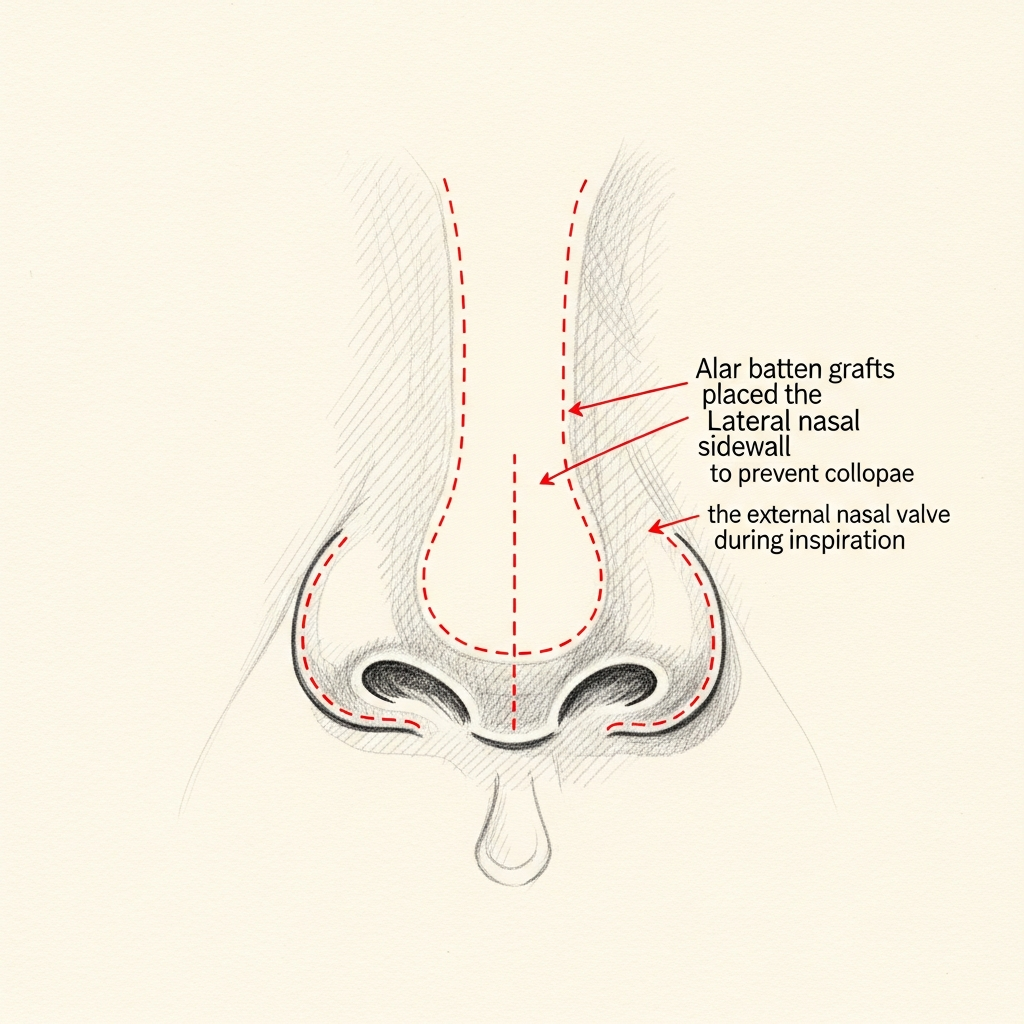
External
Alar batten or lateral crural grafts
The external valve is the lateral wall of the nostril, supported by the lower lateral cartilage. Collapse here produces visible inward movement of the nostril with strong inhalation.
Alar batten or lateral crural strut grafts add structural support to the sidewall — preserving airway patency under inspiratory pressure.
Illustrative diagrams. Most patients with significant valve collapse benefit from a combined internal-and-external approach.
01 · Why Dr. Mourad
Diagnosis first, then a plan that fits.
Dr. Mourad evaluates the nasal valve specifically at every functional consultation — collapse is missed when it is not actively looked for.
When valve collapse is the diagnosis, structural grafting with autologous cartilage is the durable answer; non-structural in-office options are discussed candidly.
Function is the goal; cosmetic change is a side effect that is planned, not stumbled into.
Begin the conversation
A careful, honest evaluation is the right first step.
Cost, Financing & Insurance
Nasal Valve Collapse Treatment Cost, Financing & Insurance in NYC
The cost of nasal valve collapse treatment depends on the location and degree of valve weakness, whether the internal or external valve is involved, the technique selected, and whether the treatment is performed alone or with other nasal airway surgery.
Nasal valve repair is a functional procedure that treats nasal obstruction, so it may be covered by insurance when it is medically necessary. Coverage often depends on symptoms, examination findings, prior treatment, and the patient’s insurance plan. Our office can help review benefits and guide patients through preauthorization when appropriate.
What May Affect Cost
- Internal vs external valve involvement
- Degree of valve weakness
- Repair technique used
- Whether grafting is required
- Whether combined with other nasal surgery
- Insurance plan requirements
This information is educational and is not a guarantee of pricing, insurance coverage, reimbursement, financing approval, or surgical candidacy. A personalized estimate is provided after consultation. Insurance coverage depends on the patient’s plan, medical necessity, documentation, and carrier requirements. Financing terms are determined by third-party financing providers.
05 · In Dr. Mourad's Words
Educational videos.
Short educational films and patient perspectives from the Manhattan practice.
Nasal Valve Collapse Surgery Explained
Dr. Mourad explains nasal valve collapse — how it is diagnosed and the surgical options for restoring nasal breathing.
Dr. Mourad in Practice
An overview of the practice and philosophy.
Patient Perspective
A patient discusses her experience before, during, and after surgery.
Inside the Consultation
How Dr. Mourad evaluates anatomy, goals, and candidacy.
From the Patient Gallery
A representative rhinoplasty result.
A female patient in her 20s, documented in standardized studio conditions before and after surgery. Written photographic consent on file. Results vary by patient; this case is representative, not predictive.
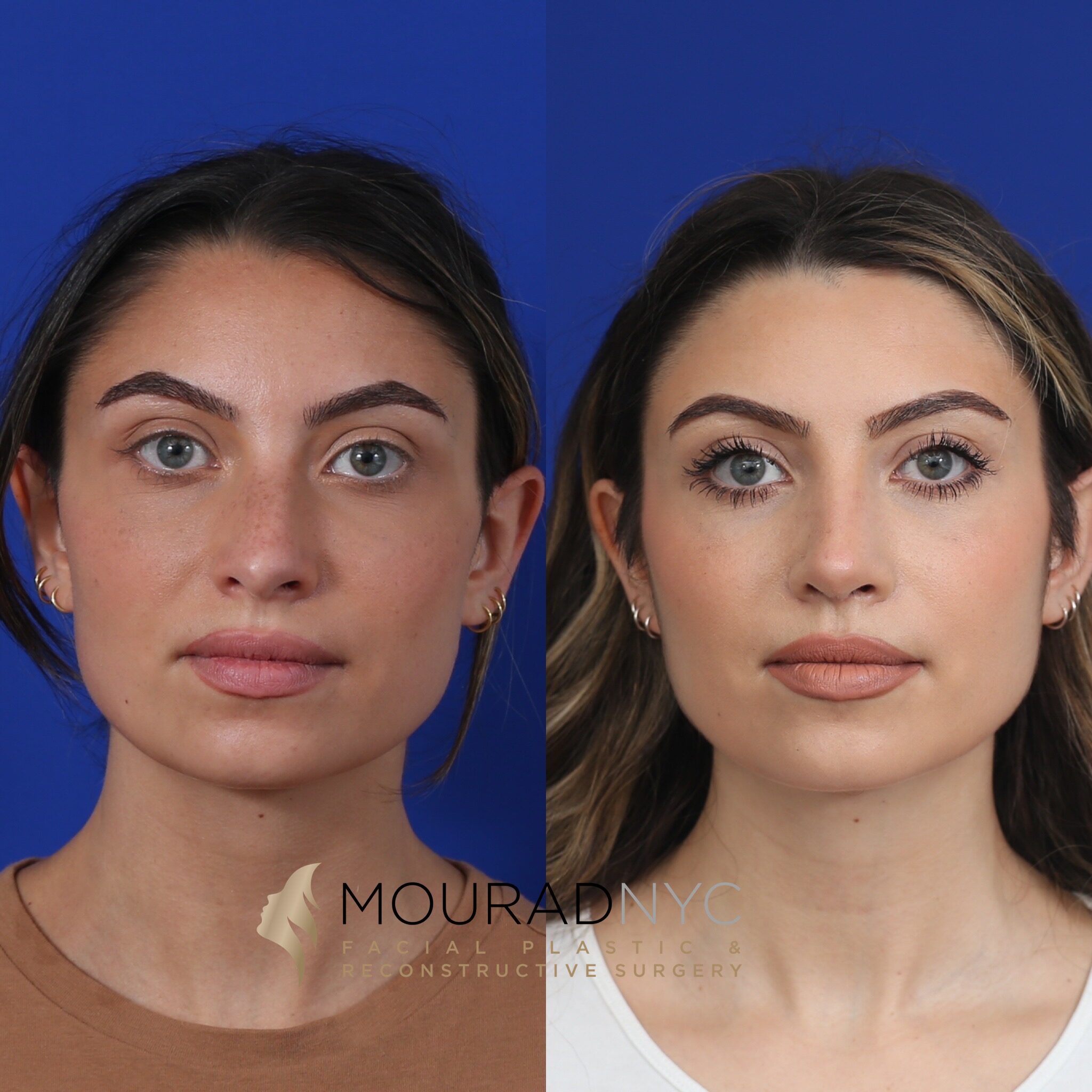


Pre and post-operative comparison · Written consent on file
06 · Recovery
What healing actually looks like.
Stage 01
First 24 Hours
Initial recovery focuses on rest, hydration, and following all post-operative instructions exactly. Pain is managed with multi-modal non-narcotic protocols where appropriate.
Stage 02
Week 1
Swelling and bruising peak in the first few days and improve steadily through the first week. Most patients are presentable for casual social activity by the end of week two.
Stage 03
Weeks 2 – 4
Through weeks two to four the early result begins to settle. Light cardio resumes around three weeks; vigorous exertion and contact activities are deferred per the operative plan.
Stage 04
Months 1 – 6
The final refined result emerges progressively over the following months as residual swelling continues to resolve. Follow-up visits are scheduled across the first year.
Have a specific question?
Send a brief note describing your anatomy or concerns — the office will route it directly to Dr. Mourad for review.

Before You Arrive
Your consultation, prepared.
Bring photographs relevant to your concern, when available.
Bring records from any prior surgery, when available.
List current medications, supplements, and blood-thinning agents.
Note any prior anesthesia issues or chronic medical conditions.
Allow 60 minutes for the first consultation.
Bring questions; no decisions are made at the first visit.
Patient Reviews
Nasal Valve Patient Experiences
Selected public patient reviews. Individual experiences vary.
“I can now say I can breathe better than I ever have”
Real patient experiences
Selected public reviews from patients of the practice.
Your privacy matters
We never share personal health information.
Board-certified expertise
Dual board-certified facial plastic and reconstructive surgeon.
Individual results vary. Reviews reflect individual experiences and are not a guarantee of outcome.
Frequently Asked
Patient questions, honestly answered.
Nasal valve collapse refers to failure of the internal or external valve structures that normally resist inward movement during inspiration, producing dynamic airflow obstruction. A deviated septum is a displacement of the central septal cartilage or bone that narrows one nasal airway statically. Both can coexist and contribute to symptoms, but the physical exam maneuvers and visual findings differ: valve collapse is often evident with inspiratory wall movement while septal deviation is visible as a midline shift or lateral displacement. Definitive treatment decisions require an in-person assessment to determine whether valve reconstruction, septoplasty, or both are indicated.
Patients with valve-related obstruction commonly report difficulty drawing air through the nose, nasal flaring with effort, or intermittent improvement when manually supporting the sidewall. In the office, the surgeon will observe inspiratory collapse at rest or with forced inspiration and may use maneuvers such as the modified Cottle to reproduce symptom relief. Nasal endoscopy can document dynamic collapse and rule out intranasal lesions. Objective testing such as rhinomanometry or acoustic rhinometry can supplement the exam but do not replace the targeted clinical assessment.
Diagnosis is primarily clinical: careful inspection during quiet and deep inspiration, palpation of lateral wall mobility, and the Cottle or modified Cottle maneuvers are central. Nasal endoscopy under topical anesthesia allows dynamic visualization of the internal valve and lateral crura. In selected cases, rhinomanometry, acoustic rhinometry, or imaging help quantify obstruction or reveal concurrent problems but may miss dynamic collapse. A comprehensive diagnosis integrates symptoms, exam findings, and adjunctive tests to define which anatomic zone requires repair.
Initial management includes medical therapy for reversible contributors: topical nasal steroids for mucosal inflammation and saline irrigation for mucociliary clearance. External dilators, internal adhesive stents, and short-term intranasal devices can provide symptomatic relief and serve as a diagnostic trial for valve-related benefit. These measures are appropriate when inflammation is present or as temporizing options, but persistent mechanical collapse despite conservative care usually warrants surgical consideration. The decision to operate depends on symptom burden, exam findings, and response to these non-surgical trials.
Internal valve narrowing is commonly addressed by widening the middle vault with spreader grafts, dorsal onlay grafts, or lateral crural strut grafts depending on the anatomy. External valve insufficiency is treated with alar batten grafts, lateral crural grafts, or suspension sutures to stiffen and lateralize the lateral nasal wall. Many patients require a combination of techniques tailored to the precise site and degree of collapse; adjunctive septoplasty or turbinate reduction is performed when other anatomic contributors are present. Approach selection—endonasal or open—depends on exposure needs and prior surgical history.
Common sources of structural grafts are septal cartilage, auricular (ear) cartilage, and costal (rib) cartilage when greater volume or strength is required. Septal cartilage is preferred when available because it is locally situated and avoids a separate incision; auricular cartilage is useful when septal tissue is insufficient and provides a curved graft for alar support. Rib cartilage is reserved for extensive reconstructions, such as severe post-rhinoplasty collapse or saddle deformity, when more robust material is necessary. Choice of donor site is individualized based on prior surgery, the volume of graft needed, and the reconstructive goals discussed during consultation.
The endonasal approach uses internal incisions and is appropriate for limited graft placement or small structural adjustments with preserved tip exposure. An open approach provides wide bilateral exposure of the middle vault and tip and is chosen when complex grafting, multizonal reconstruction, or revision surgery is anticipated. Open exposure facilitates precise graft shaping and placement but involves a small transcolumellar incision; endonasal techniques avoid external incision but can limit visibility in complex cases. Dr. Mourad selects the approach that best balances exposure, graft control, and the patient’s prior operative history.
Early postoperative congestion and edema are expected for 1–2 weeks and are not predictive of final airway outcome. Many patients notice measurable breathing improvement within 2–6 weeks as swelling subsides, but structural remodeling and final airway behavior often evolve over 3–6 months. Nasal splints or internal packing, when used, are typically removed within 1–7 days depending on the procedure. Activity restrictions are conservative: avoid strenuous exertion and nasal trauma for 2–6 weeks and follow surgeon-specific return-to-work guidelines discussed at the visit.
Risks include persistent or recurrent obstruction, asymmetry of the external nose, graft visibility or irregularity, infection, and donor-site morbidity when autologous cartilage is harvested. Over- or undercorrection of lateral wall position can necessitate revision in some cases. General surgical risks such as bleeding and anesthesia-related events also apply. A frank discussion of these possibilities and the contingency plan for revision—should it become necessary—is part of the preoperative consultation.
Prior rhinoplasty often alters native cartilage availability and the relationship between the middle vault and tip, making valve repair more complex. Scar tissue and previous grafts may limit options and require alternative donor sites such as ear or rib cartilage. Revision valve repair typically requires more extensive exposure and precise grafting to recreate lost support rather than simple maneuvers used in primary cases. Dr. Mourad outlines these differences during consultation and explains the staged options and realistic expectations for revision reconstruction.
Clinical references
This page draws on published clinical practice guidelines and public-health references. These sources inform general patient education and do not replace an individual evaluation with Dr. Mourad.
- 01American Academy of Otolaryngology–Head and Neck Surgery Foundation. Clinical Consensus Statement: Septoplasty with or without Inferior Turbinate Reduction. Otolaryngology–Head and Neck Surgery. 2015;153(5):708–720. AAO-HNSF consensus
- 02U.S. National Library of Medicine (MedlinePlus). Nose Injuries and Disorders. MedlinePlus
The Most Important Step
Your expert consultation.
A careful evaluation by a double board-certified physician is the right first step. The conversation is unhurried, the diagnosis is honest, and the operative plan is built around what your anatomy can sustain and what you actually want.